Edited or deleted, you can get it back
Each edit keeps the version before it. Deleting goes to Trash first, and you can restore it any time; deleting for good only happens inside Trash.
Notes and tasks, on your computer and your phone. Your data stays on your own devices, and the app works offline.
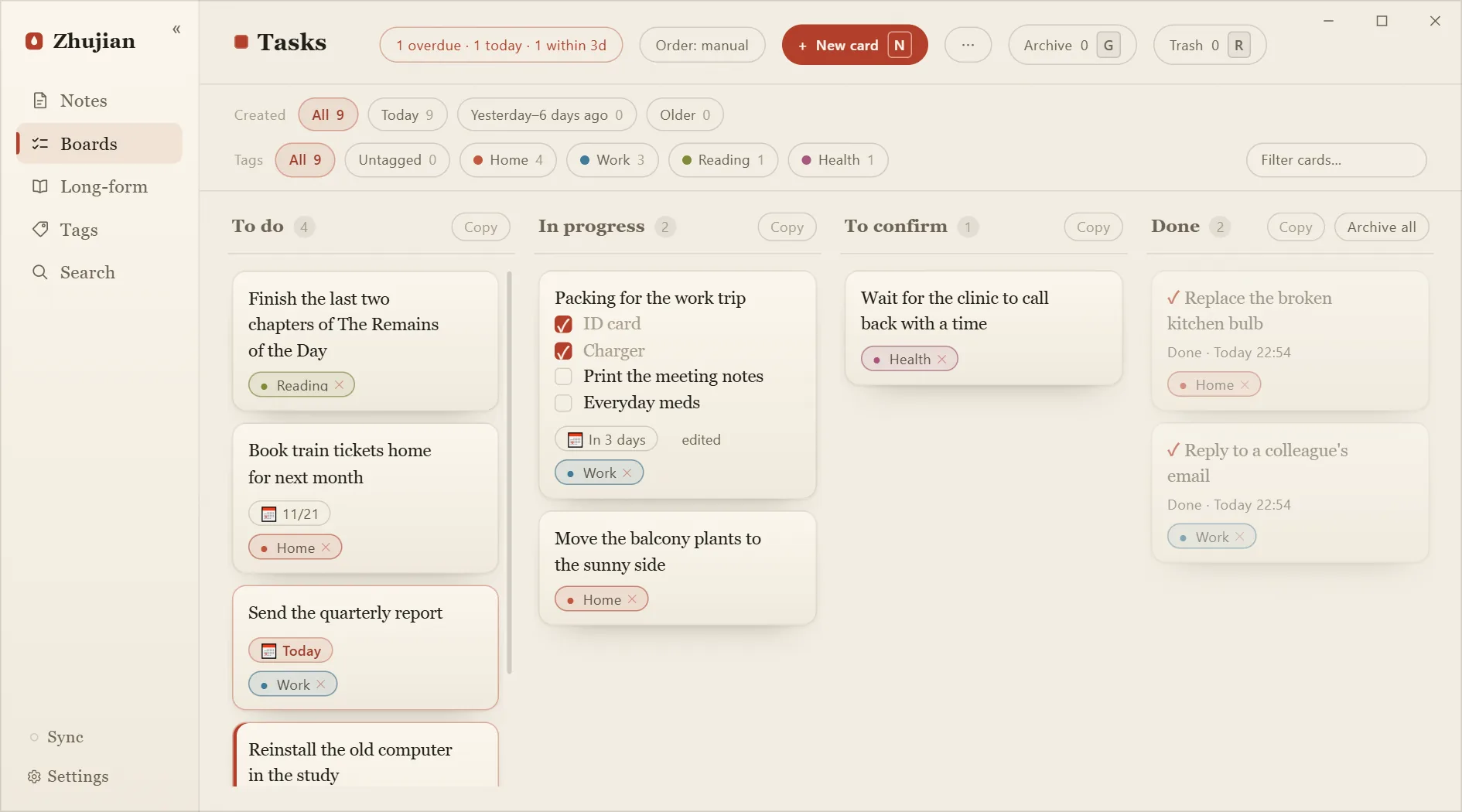
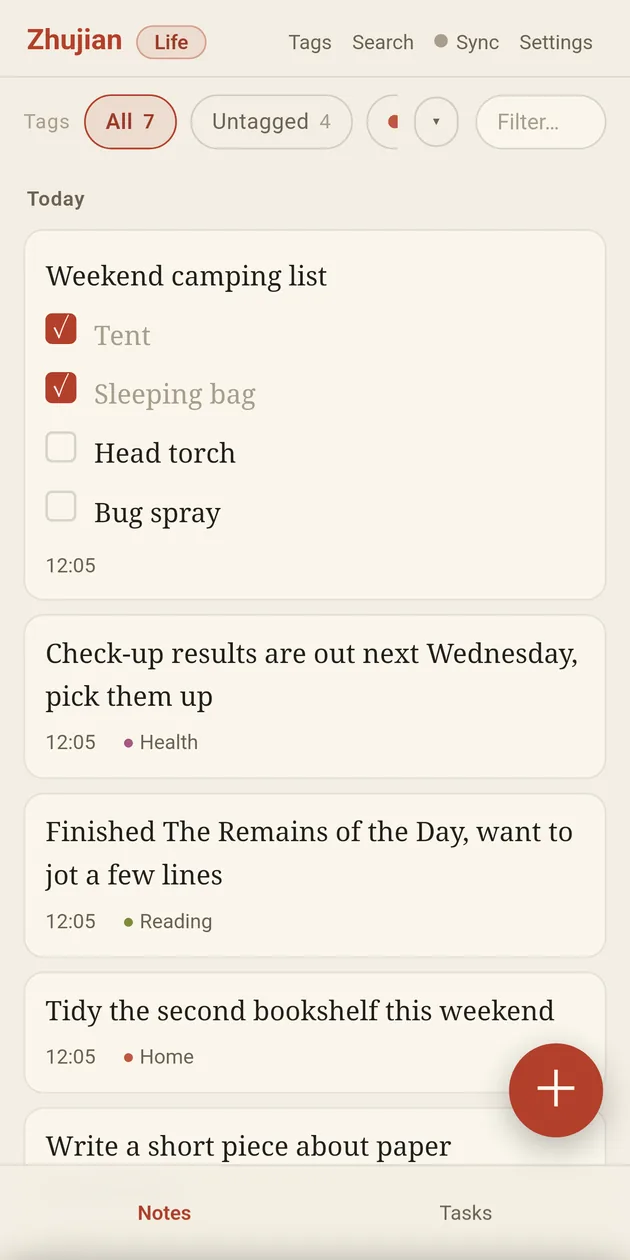
The global hotkey Ctrl+Alt+N brings up a quick note. Press Enter and it's saved to Notes; the window goes away on its own. Screenshots paste straight in. On your phone, tap the round button at the bottom right to write.
In Notes, tag it. When it becomes something to do, turn it into a task: it stays the same item, with no second copy.
To do, In progress, To confirm, Done. Drag tasks along; finished ones go to Archive, where you can look them up later.
Each edit keeps the version before it. Deleting goes to Trash first, and you can restore it any time; deleting for good only happens inside Trash.
Turn on sync and your computer and phone hold the same notebook. Everything is encrypted on your device before it leaves, so the server can't read it. On the same Wi-Fi, devices sync directly.
Finished tasks go to Archive, where you can look them up but not delete them. Look back and see what you got done.
Add, rename or remove them on the desktop. As many columns as your process has steps.
Each space is its own notebook, kept apart. Type /space in the quick note to switch.
Every action on a card has a single key: press ] to move it one column right, [ to move it back left.
On desktop, export a whole space to Markdown in one go, images and comments included; any editor can open it.
It lives in a SQLite database on your own device and works offline. Sync is optional: text and images are encrypted on your device before they leave, so the server only ever handles ciphertext.
The app has no analytics and no tracking. With sync off, builds downloaded from zhujian.app only check it for updates; store builds contact nothing at all.
No polishing, no summaries, no auto-sorting. What you write is what stays.
Windows and Android are the supported builds; once installed they check for new versions and prompt you. The HarmonyOS build is on Huawei AppGallery, which handles its updates. macOS and Linux are early builds. There is no iPhone version.
Early build macOS (Apple silicon) and Linux (x86_64): unsigned, so allow them by hand on first launch; on Linux the hotkey and tray may be incomplete on some desktops. Download dmg AppImage .deb
What's new (changelog, in Chinese)
Check your download (SHA-256): Desktop Android How (in Chinese)
Desktop updates are signed by the developer and checked before installing; the Windows installer is not code-signed.
Questions? Email 3069848@qq.com